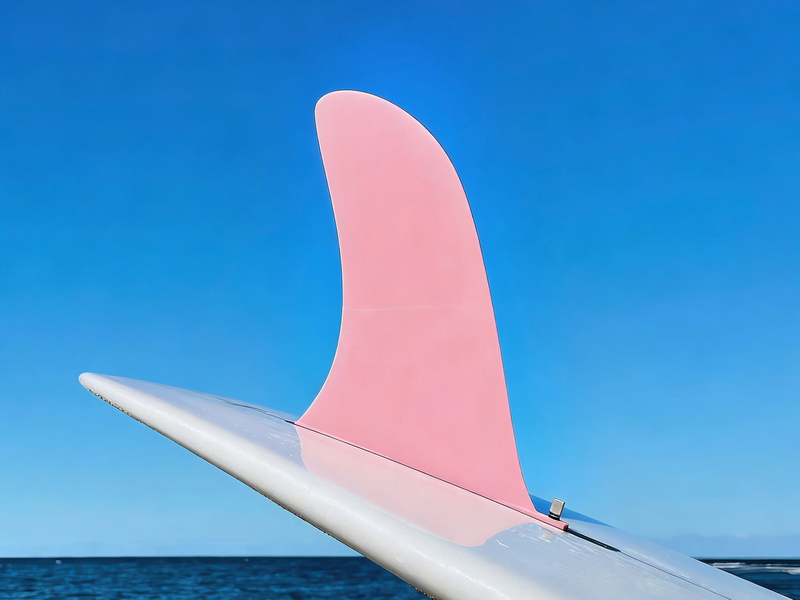
You bought a noserider. Nine-something feet of flat rocker, wide point forward, glassed heavy. It should walk to the nose without thinking. But it doesn't. The front foot hits somewhere around the second stringer and the board just… sits there. Heavy. Reluctant.
The board isn't the problem. Nine times out of ten, it's the fin.
What "stuck" actually means
A noserider needs to do two things at once: pivot under your back foot when you walk forward, and hold under your front foot once you get there. A fin that's wrong for the board disrupts both.
If the rake is too steep — meaning the fin sweeps a long way back from base to tip — the board wants to track in a straight line. You can't pivot it. You get to the nose and the tail is already starting to slide. You step back. You lose the moment. It feels like work.
If the fin is too shallow — not enough base depth for the size of the board — there's no hold when the weight goes forward. The tail releases before you've even settled your front foot.
Neither of those is a board problem. Both are fixable with a different fin.
Three things to look at
Before you swap anything, pull the fin and look at it next to your hand:
- Depth. How far down does the fin go? For a nine-plus longboard, you want 9 to 10 inches of depth. Under that and you're working with not enough hold.
- Rake. Hold the fin upright and look at how far back the tip sits relative to the base. A high-rake fin sweeps well back. A low-rake fin stands more upright. For noseriding, you want less rake — a more upright template that lets the board pivot without dragging the tail.
- Box position. US Box fins can move forward and back in the box. Most people leave the fin in the middle. Slide it back 10–15mm and you shorten the pivot distance. The board will feel freer under the back foot.
What works
The setup that comes up most: a 9.5" fin with a moderate rake — think traditional D-fin or a gentle single-foil longboard template — positioned toward the back of the box. Not all the way back. Just away from centre.
The fin should feel like it wants to arc, not track. When you push on the tail, the board should swing. That's what lets you walk to the front.
Our Longboard | Resin | US Box fins run in that range — moderate rake, enough depth for boards in the nine-to-eleven foot range. If your current fin came with the board from a shop floor, chances are it's a little tall and a little steep. Swap it for something that prioritises pivot over drive and see what happens.
If you're riding something with a steeper nose rocker — more of a performance log shape — you might actually want to go the other direction: more rake, more drive, a fin that helps you hold a longer line. But for a true flat-rocker noserider? Keep the rake down.
The other fix nobody mentions
Wax. Specifically: not enough wax on the tail. If you're slipping back to your pad or back deck before the board pivots, you lose the window for walking. A fresh coat of traction wax in the back third helps you hold position long enough to let the board do its thing.
But fix the fin first.
If you want to go deeper on how fin shape affects feel, the Drop a Noserider guide walks through the setup logic for longboard fins. And if you're running a raked template and want to try something more upright, our Longboard Rake | Resin | US Box is worth a look — a bit more template, a bit more pivot.
New fins are cheaper than a new board. Try the swap before you blame the shape.